On Labor Productivity, Corporate Profits and Parasitic Capitalists
Sun Apr 17, 2011 8:35 pm
by David Moros
...Labour-power is, in our present-day capitalist society, a commodity like every other commodity, but yet a very peculiar commodity. It has, namely, the peculiarity of being a value-creating force, the source of value, and, moreover, when properly treated, the source of more value than it possesses itself. In the present state of production, human labour-power not only produces in a day a greater value than it itself possesses and costs; but with each new scientific discovery, with each new technical invention, there also rises the surplus of its daily production over its daily cost, while as a consequence there diminishes that part of the working-day in which the labourer produces the equivalent of his day's wages, and, on the other hand, lengthens that part of the working-day in which he must present labour gratis to the capitalist.
And this is the economic constitution of our entire modern society: the working class alone produces all values. For value is only another expression for labour, that expression, namely, by which is designated, in our capitalist society of today, the amount of socially necessary labour embodied in a particular commodity. But, these values produced by the workers do not belong to the workers. They belong to the owners of the raw materials, machines, tools, and money, which enable them to buy the labour-power of the working class. Hence, the working class gets back only a part of the entire mass of products produced by it. And, as we have just seen, the other portion, which the capitalist class retains, and which it has to share, at most, only with the landlord class, is increasing with every new discovery and invention, while the share which falls to the working class (per capita) rises but little and very slowly, or not at all, and under certain conditions it may even fall.
But, these discoveries and inventions which supplant one another with ever-increasing speed, this productiveness of human labour which increases from day to day to unheard-of proportions, at last gives rise to a conflict, in which present capitalistic economy must go to ruin. On the one hand, immeasurable wealth and a superfluidity of products with which the buyers cannot cope. On the other hand, the great mass of society proletarianized, transformed into wage-labourers, and thereby disabled from appropriating to themselves that superfluidity of products. The splitting up of society into a small class, immoderately rich, and a large class of wage-labourers devoid of all property, brings it about that this society smothers in its own superfluidity, while the great majority of its members are scarcely, or not at all, protected from extreme want.
This condition becomes every day more absurd and more unnecessary. It must be gotten rid of; it can be gotten rid of. A new social order is possible, in which the class differences of today will have disappeared,...
http://www.marxists.org/archive/marx/works/1847/wage-labour/intro.htm
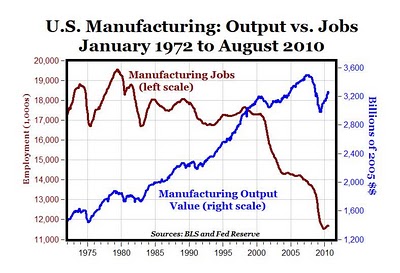
What Alan Greenspan described in an interview on "Meet the Press" today with David Gregory is the what Frederick Engels was describing in the quote from above written in 1891. Increased corporate profits since 2009 have resulted from increased productivity of labor, that is, the recent run-up of corporate profits as reflected on Wall Street have come at the expense of the value creators i.e. the working class. Thus, none other than the former Chairman of the Federal Reserve of the United States from 1987 to 2006 confirmed Marxist economic analysis.
If the increased value created in production as a result of greater worker productivity doesn't go to the producers, then it goes into the stuffed pockets of the parasitic capitalists!
The working class, at best, work harder and produce more output per time period, with no comensurate increase in wages. Workers, at worst, loose their jobs, their livelihood, because their labor as become too productive!
Also, Greenspan finds "bothersome" the fact that "we're now beginning to see that productivity growth flatten out" and "profit margins are now beginning to tilt downward" thus "unless we get the momentum that occurs when cash flows are rising and stock prices and equity values are moving on the economy as a whole, we're going to have some tough problems ahead"! In other words, if the productivity of labor doesn't keep pace with its recent increasing levels, at least since 2009, then economically speaking, the economy tanks. This seems to be the gist of Greenspans analysis.
Yes, these economic conditions for the working class do become more absurd and unbearable and must be gotten rid of, and thus I agree with what Adaoma recently posted concerning a working class political party here in the USA that:
"We need another party. We need a workers party. We need a labor party! Only workers can build a party that will serve in our best interests." http://groups.yahoo.com/group/laborpartypraxis/message/26857
David
---
MR. GREGORY: Back now with our roundtable. Alan Greenspan, I want to talk economy writ large. And a couple pieces of data here, from the interview with Secretary Geithner, he says, referring to private economists, he thinks that unemployment could get to 8 percent or below by the end of 2012. And this is interesting, too. Persistently high unemployment but look at the performance of the stock market while President Obama's been president. Up in 2009 from 7949 to over 12,000. We've got, as you always say on this program, that's real money, that's real wealth, and yet we have persistently high unemployment. What, what is your view? What is this outlook you're seeing?
DR. GREENSPAN: Well, first of all, the major reason why the stock market, in fact, asset values in general, came off those extraordinary lows in early 2009 is that productivity improved very dramatically in the business sector. That meant that profits and cash flows would be engendered in a very substantial amount, which pushed asset prices up to an extent that, coupled with the increased contributions, 401(k)s added a trillion dollars to the actual net worth of the individual households who hold them. And they are very big spenders, and that has been a very important factor in keeping the economy going up.
MR. GREGORY: But you're saying companies doing more with less. The question is when do they start spending and creating jobs?
DR. GREENSPAN: Well, the problem, basically, is that there was a contradiction in those who say that you want one and not the other. Increasing productivity, by definition, means that you are producing more goods with fewer employers.
MR. GREGORY: Mm-hmm.
DR. GREENSPAN: Now, what--employees. What is happening now is we're now beginning to see that productivity growth flatten out, and that's where all those jobs are coming from very recently.
MR. GREGORY: Right.
DR. GREENSPAN: And so that, if you're asking me where's the unemployment rate going to be, I would say it's going to depend on two things. One, there's a lot of headwinds that are hitting the economy now and slowing it down, and we are in a soft patch. In all likelihood, we will recover out of that. But what I find bothersome is that profit margins are now beginning to tilt downward, and unless we get the momentum that occurs when cash flows are rising and stock prices and equity values are moving on the economy as a whole, we're going to have some tough problems ahead.
http://www.msnbc.msn.com/id/42612533/ns/meet_the_press-transcripts/
Watch interview at:
http://www.msnbc.msn.com/id/3032608/vp/42632569#42632569
---
LabourPartyPraxis discussion - subscribe
